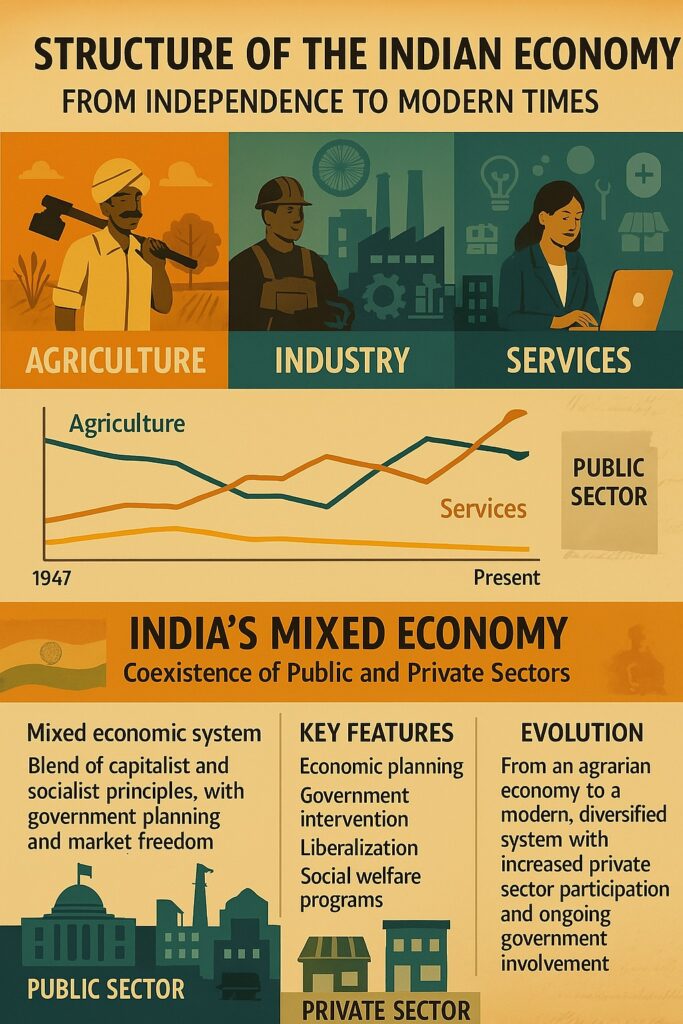
 Structure of Indian Economy
1. Basic Characteristics of the Indian Economy
- Mixed Economy: Coexistence of public and private sectors.
- Developing Economy: High population, low per capita income, and regional disparities.
- Dualistic Structure: Presence of both modern and traditional sectors (e.g., organised manufacturing and subsistence farming).
- Labour Abundance: High population engaged in informal and unorganised sectors.
- Resource Diversity: Rich in natural resources like coal, iron, rivers, and fertile plains.
2. Three Main Sectors of the Indian Economy
a) Primary Sector (Agriculture and Allied Activities)
- Involves extraction and use of natural resources.
- Includes agriculture, forestry, fishing, mining.
- Employs over 40% of the workforce (as per recent estimates).
- Contribution to GDP has declined to about 15–18%, showing a structural shift.
- Still vital for rural livelihoods and food security.
b) Secondary Sector (Industry and Manufacturing)
- Involves transformation of raw materials into finished goods.
- Includes manufacturing, construction, electricity, gas, and water supply.
- Employs around 25% of the workforce.
- Contribution to GDP: about 25–28%.
- Growth driven by small-scale industries, textiles, automobiles, pharmaceuticals, and steel.
c) Tertiary Sector (Services)
- Provides intangible goods like services, trade, education, transport, IT, banking, and tourism.
- Fastest growing sector in the Indian economy.
- Contributes over 50% to GDP.
- Employs around 35% of the workforce.
- India is a global leader in IT and business process outsourcing (BPO).
3. Structural Changes in the Indian Economy
Over the decades, India has undergone significant structural changes:
- Decline in agriculture’s share in GDP, but not in employment proportionately.
- Rise of services sector as the dominant contributor to GDP.
- Growth of urban centres driven by industrial and service activities.
- Expansion of informal sector, employing the majority of the workforce.
- Increased focus on industrial corridors, smart cities, and digital economy.
4. Challenges in the Structure
- Jobless growth: High GDP growth but low employment generation.
- Regional imbalance: Western and southern India more industrialised than eastern and central regions.
- Low agricultural productivity and rural distress.
- Overdependence on services with insufficient industrial base.
- Large informal/unorganised sector with low wages and no social security.
5. Government Initiatives
To address structural imbalances, several initiatives have been taken:
- Make in India – Boost manufacturing and exports.
- Digital India – Promote IT infrastructure and digital services.
- Skill India – Develop employable youth.
- PM Gati Shakti – Enhance infrastructure and logistics.
- Atmanirbhar Bharat – Encourage self-reliance and local production.
Conclusion
The structure of the Indian economy reflects its transition from an agrarian to a service-led economy, with industry playing an important intermediary role. Understanding this structure is essential for planning development strategies, addressing regional disparities, and ensuring inclusive and sustainable economic growth.
Read: Economy Notes