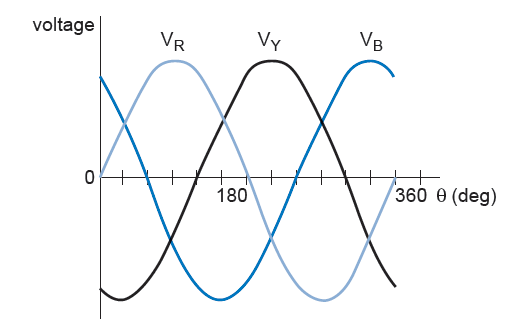
Three-Phase Alternating Current (AC) circuits is the backbone of modern electrical power systems. They are widely used in generation, transmission, and distribution of electricity because of their efficiency, reliability, and ability to deliver constant power. In a three-phase system, three alternating voltages of equal magnitude and frequency are generated, each displaced in phase by 120° electrical from the others.
Compared to single-phase AC circuits, three-phase AC circuits are more efficient, economical, and reliable, especially for high-power applications. They deliver nearly constant power, require less conductor material for the same power transfer, and ensure smooth and uniform torque in electrical machines. Due to these advantages, three-phase systems are universally adopted for operating large motors, transformers, and industrial equipment.
Generation of Three-Phase Supply
Three-phase power is generated using an alternator (AC generator) that consists of three identical windings (coils). These windings are physically displaced by 120° electrical from one another.
The three separate coils, commonly labeled Phase R, Phase Y, and Phase B, are symmetrically placed around the inner circumference of the stator, which is the stationary part of the alternator.
At the center of the stator is the rotor, which is the rotating part of the machine. The rotor acts as a powerful electromagnet. When the rotor is driven by a turbine or engine, it produces a rotating magnetic field.
As this rotating magnetic field cuts across the stationary stator windings, an alternating electromotive force (EMF) is induced in each coil in accordance with Faraday’s law of electromagnetic induction.
Because the three coils are separated by 120°, the magnetic field reaches its maximum value in each coil at different instants of time, resulting in phase-shifted voltages.
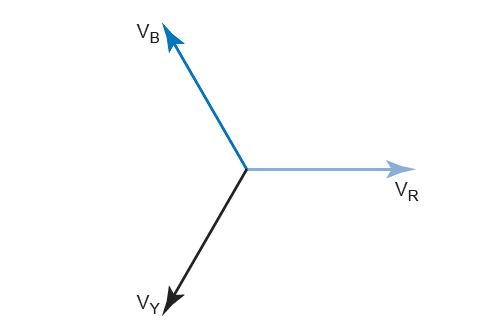
From the waveform diagram, it is clear that at any instant along the horizontal (time) axis, the algebraic sum of the three phase voltages is zero, which reflects the balanced nature of a three-phase system. This condition becomes more evident when the same voltages are represented using a phasor diagram, where each voltage is treated as a vector quantity with both magnitude and phase angle. When these three phasors are drawn to scale and placed head-to-tail, the resultant vector can be obtained by joining the starting point of the first vector to the tip of the last vector. In a balanced system, the phasors form a closed triangular figure, meaning the starting and ending points coincide, and therefore the resultant vector is zero, confirming that the instantaneous sum of the three phase voltages is zero.
Characteristics of Three-Phase Power
Unlike single-phase power, where the power falls to zero twice in every cycle, the combined power in a three-phase system never becomes zero. This is due to the overlapping nature of the three phase voltages, which ensures a smooth and continuous power output.
Star-connected (Y-connected) Three-Phase System
2. Star and Delta Connections
The three windings can be interconnected in:
-
Star (Wye) connection, which provides a neutral point
-
Delta connection, which uses only three line conductors
3. High Efficiency
Three-phase systems can transmit more power with less conductor material (copper or aluminum) compared to single-phase systems, making them more economical and efficient for power generation and transmission.
In an alternator, the field system is housed in the rotor, while the winding in which the emf is generated is placed in the stator. This arrangement is adopted for the following important reasons:
(a) When large voltages are generated, heavy insulation is required. If this additional insulated mass were mounted on the rotor, extra mechanical power would be needed to rotate it, thereby reducing the overall efficiency of the machine. By placing the armature winding in the stator, heavy insulation can be provided without affecting the efficiency.
(b) Although the contact resistance between brushes and slip rings is small, a large output current (of the order of hundreds of amperes) would result in significant I2R power losses. In practice, only a small direct current—typically a few amperes or tens of amperes—is required to energize the field system. Therefore, supplying the field current through slip rings results in minimal power loss, while the stator winding can be directly connected to external terminals.
(c) In very small alternators, the rotor may use permanent magnets to produce the rotating magnetic field. This completely eliminates the need for slip rings and brushes. Such machines are known as brushless alternators.
Compared to single-phase AC circuits, three-phase AC circuits are more efficient, economical, and reliable, especially for high-power applications. They deliver nearly constant power, require less conductor material for the same power transfer, and ensure smooth and uniform torque in electrical machines. Due to these advantages, three-phase systems are universally adopted for operating large motors, transformers, and industrial equipment.
What is a Three-Phase System?
- A three-phase system consists of three sinusoidal voltages of equal magnitude and frequency, but displaced in phase by 120° from each other.
- These voltages are typically denoted as Phase A, Phase B, and Phase C.
- The system can be represented either in a star (Y) or delta (Δ) configuration, depending on the application.
Why Three-Phase Instead of Single-Phase?
- Constant Power Delivery: Unlike single-phase systems, three-phase circuits deliver power that is more uniform over time, reducing vibrations in motors and improving efficiency.
- Reduced Conductor Material: For the same amount of power, three-phase systems require less conductor material compared to single-phase.
- Higher Efficiency in Machines: Motors and generators designed for three-phase supply are more compact, efficient, and have better starting torque.
- Scalability: Large-scale power transmission and industrial loads are more easily managed with three-phase systems.
Key Features
- Balanced System: When loads are equal across all three phases, the system is said to be balanced, leading to optimal performance.
- Neutral Conductor: In star connections, a neutral wire may be used to provide multiple voltage levels (line-to-line and line-to-neutral).
- Applications: Found in power plants, factories, data centers, and even household appliances in some regions.
Importance in Electrical Engineering
Three-phase AC circuits are not just a technical convenience—they are a necessity for modern infrastructure. They enable:
- Long-distance transmission of power with minimal losses.
- Operation of heavy machinery and industrial equipment.
- Stable and reliable electricity supply for both commercial and residential use.
Would you like me to also create a diagrammatic introduction (like a simple star and delta connection illustration) to visually complement this text? That way, it becomes more classroom-ready and easier to grasp.