Table of Contents
What is a TRIAC?
A TRIAC is essentially a bi-directional thyristor. You can think of it as two SCRs connected in anti-parallel (back-to-back) with a common gate terminal. This unique internal structure allows it to be triggered into conduction by either a positive or a negative gate pulse, regardless of the polarity of the voltage across its main terminals.
- Terminals: MT1 (Main Terminal 1), MT2 (Main Terminal 2), and G (Gate).
- Symbol: Two triangles pointing in opposite directions with a single gate lead.
2. The Four Modes of Operation (Quadrants)
A TRIAC can be triggered in four different ways, depending on the polarity of MT2 and the Gate relative to MT1:
| Quadrant | MT2 Polarity | Gate Polarity | Sensitivity |
|---|---|---|---|
| I | Positive (+) | Positive (+) | Highest (Most Sensitive) |
| II | Positive (+) | Negative (-) | Moderate |
| III | Negative (-) | Negative (-) | High |
| IV | Negative (-) | Positive (+) | Lowest (Avoid if possible) |
Note: Most designers prefer operating in Quadrants I and III for symmetrical and reliable triggering.
3. Key Mathematical Parameters
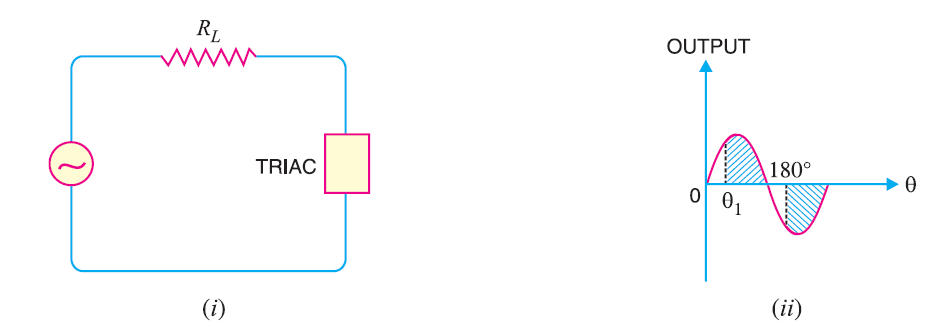
When using a TRIAC in a phase-controlled circuit (like a light dimmer), the RMS Output Voltage ($V_{rms}$) is controlled by the firing angle $\alpha$.
The formula for the RMS voltage across the load for a TRIAC is:
$$V_{rms} = V_s \sqrt{\frac{1}{\pi} \left( \pi – \alpha + \frac{\sin 2\alpha}{2} \right)}$$
Where $V_s$ is the RMS supply voltage. Note that unlike a half-wave rectifier, the TRIAC provides power during both half-cycles.
4. Advantages and Limitations
Advantages:
- Consists of a single device instead of two SCRs, saving space and cost.
- Can be triggered by both positive and negative gate pulses.
- Eliminates the need for a bridge rectifier in AC power control.
Limitations:
- $dv/dt$ rating: TRIACs are susceptible to accidental triggering if the voltage rises too quickly.
- Lower Power: Generally available in lower power ratings compared to heavy-duty SCRs.
- Symmetry issues: It may not trigger at exactly the same angle in both half-cycles, leading to harmonics.
5. Common Applications
- Domestic Light Dimmers: Controlling the brightness of incandescent lamps.
- Fan Speed Controllers: Adjusting the speed of single-phase induction motors.
- Small Electric Heaters: Precise temperature control in appliances.
- AC Solid State Relays (SSR): For noiseless switching in industrial automation.