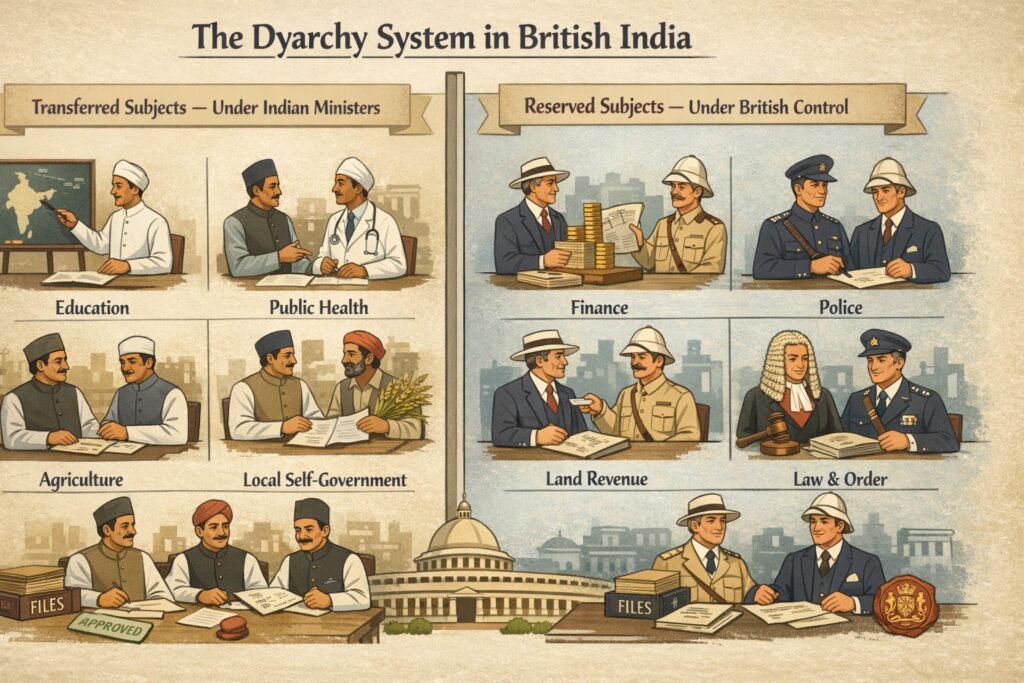
Q1. The DYARCHY as introduced by the Government of India Act, 1919 postulated which of the following ?
(a) A system of dual government in Bengal
(b) Backward classes were entitled to vote
(c) A few subjects were transferred to the Provincial Ministries and the rest retained by the Executive Council
(d) Hindus and Muslims could vote separately
(UPSC Prelims 1980)
Answer: (c) A few subjects were transferred to the Provincial Ministries and the rest retained by the Executive Council
Explanation: The Dyarchy system divided provincial subjects into transferred and reserved categories, with Indian ministers handling transferred subjects and British officials retaining control over reserved ones.
Q2. Which of the following Acts was introduced by the Britishers to remove the shortcomings of the Regulating Act?
(a) Pitt’s India Act, 1784
(b) Rowlatt Act
(c) The Charter Act of 1793
(d) Government of India Act 1919
(UPSC Prelims 1986)
Answer: (a) Pitt’s India Act, 1784
Explanation: The Pitt’s India Act was enacted to address the deficiencies of the Regulating Act of 1773, by establishing dual control between the British Government and East India Company, and improving administrative efficiency.
Q3. Montague – Chelmsford Reforms relate to
(a) Dyarchy
(b) Communalism
(c) Provincial autonomy
(d) None of the above
(UPSC Prelims 1987)
Answer: (a) Dyarchy
Explanation: The Montague-Chelmsford Reforms of 1919 introduced dyarchy in provincial governments, dividing subjects into reserved and transferred categories. This was a step toward self-governance, though limited in scope.