Q1. The first metal used by the man was
(a) Iron
(b) Copper
(c) Aluminium
(d) Gold
(UPSC Prelims 1979)
Answer: (b) Copper
Explanation:
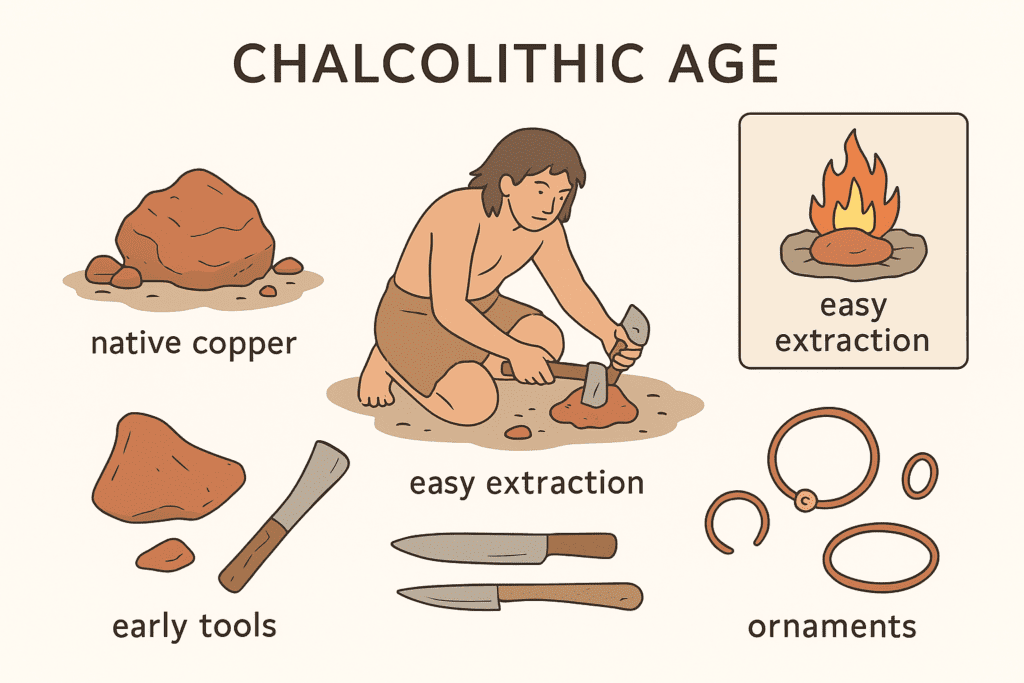
Copper was one of the earliest metals discovered and used by humans, primarily because it occurs in native form and can be easily extracted and shaped. Its low melting point and availability in nature made it ideal for early tools and ornaments, marking the beginning of the Chalcolithic Age.
Q2. Which of the following throws light on Harappan Culture ?
(a) Archaeological excavations
(b) The script on copper sheets
(c) Rock edicts
(d) All of the above
Answer: (a) Archaeological excavations
Explanation: Our understanding of Harappan Civilization comes primarily from archaeological digs at sites like Harappa and Mohenjo-daro, revealing urban planning, drainage systems, and artifacts. The script remains undeciphered, and rock edicts are from a later period.
Q3. The Indus Valley people had contacts with
(a) Egyptians
(b) Sumerians
(c) Chinese
(d) Mesopotamians
(UPSC Prelims 1980)
Answer: (b) Sumerians
Explanation: Archaeological evidence like seals and trade goods shows that the Indus Valley Civilization had commercial and cultural contacts with the Sumerians of Mesopotamia.
Q4. Lothal is connected as excavation site of the civilisation of
(a) Indus Valley Civilisation
(b) Sumerians
(c) Mesopotamians
(d) Vedic Aryan
(UPSC Prelims 1980)
Answer: (a) Indus Valley Civilisation
Explanation: Lothal, located in Gujarat, was a prominent port city of the Indus Valley Civilization, featuring a dockyard and advanced urban planning.
Q5. Lothal is
(a) A closed water system
(b) A poisonous gas
(c) A place in Gujarat where excavations have established a link with the Indus Valley civilisation
(d) Legal action taken against defectors
(UPSC Prelims 1982)
Answer: (c)
Explanation: Lothal, located in Gujarat, is an important archaeological site of the Indus Valley Civilization, known for its dockyard, urban planning, and trade links, offering insights into ancient maritime activity.
Q6. The script of Indus Valley civilisation was
(a) Persian
(b) Dravidian
(c) Sanskrit
(d) Undeciphered
(UPSC Prelims 1982)
Answer: (d)
Explanation: The script of the Indus Valley Civilization remains undeciphered, despite numerous attempts. It consists of symbols and signs found on seals and pottery, and its linguistic affiliation is still unknown.
Q7. Which of the following presents the most significant features of Indus Valley Civilisation ?
(a) Buildings with perfect arches
(b) Use of burnt mud bricks
(c) Use of sun dried mud bricks
(d) None of these
(UPSC Prelims 1984)
Answer: (b) Use of burnt mud bricks
Explanation: The Indus Valley Civilisation is noted for its urban planning and durable construction, especially the use of uniformly sized burnt mud bricks. These bricks were used in houses, drainage systems, and public buildings, indicating advanced engineering skills.
Q8. Indus Valley Civilisation was spread over
(a) Baluchistan, Sind, Punjab and Rajasthan
(b) Sind, Punjab and Kashmir
(c) Afghanistan, Sind, Punjab, Rajasthan, Gujarat and Kashmir
(d) None of these
(UPSC Prelims 1984)
Answer: (c) Afghanistan, Sind, Punjab, Rajasthan, Gujarat and Kashmir
Explanation: The Indus Valley Civilisation extended across a vast region including parts of modern-day Pakistan and India, covering Afghanistan, Sind, Punjab, Rajasthan, Gujarat, and Kashmir. This wide spread indicates its advanced urban planning and trade networks.
Q9. Which of the following was not known to Indus Valley people?
(a) Silver
(b) Copper
(c) Iron
(d) Bronze
(UPSC Prelims 1985)
Answer: (c) Iron
Explanation: The Indus Valley Civilization was a Bronze Age culture. While they used copper, bronze, and silver, iron was not known to them and came into use in later periods.
Q10. Which of the following was the principal article of food of the Indus Valley people ?
(a) Fish
(b) Palm-date
(c) Eggs
(d) Wheat
(UPSC Prelims 1986)
Answer: (d) Wheat
Explanation: Archaeological evidence shows that wheat and barley were the main food grains cultivated and consumed by the Indus Valley people. Hence, wheat was the principal article of food.
Q11. Which of the following is a characteristic feature of the Indus Valley Civilisation?
(a) Their chief deities were Mother Goddess and Shiva
(b) They worshipped bulls
(c) They had all amenities of a developed city life
(d) They did not know of iron
(UPSC Prelims 1986)
Answer: (c) They had all amenities of a developed city life
Explanation: The Indus Valley Civilisation was known for its advanced urban planning, including drainage systems, grid-patterned streets, and multi-storeyed buildings. These features reflect a developed city life, making option (c) the correct answer.
Q12. Metals known to Indus Valley Civilisation were
(a) Gold, copper, silver but not iron
(b) Silver, iron, bronze but not gold
(c) Iron, copper, gold but not silver
(d) Zinc, silver, iron but not gold
(UPSC Prelims 1987)
Answer: (a) Gold, copper, silver but not iron
Explanation: The Indus Valley Civilization was familiar with gold, copper, and silver, evident from artifacts and ornaments. However, iron was not used, as it belonged to a later technological phase in Indian history.
