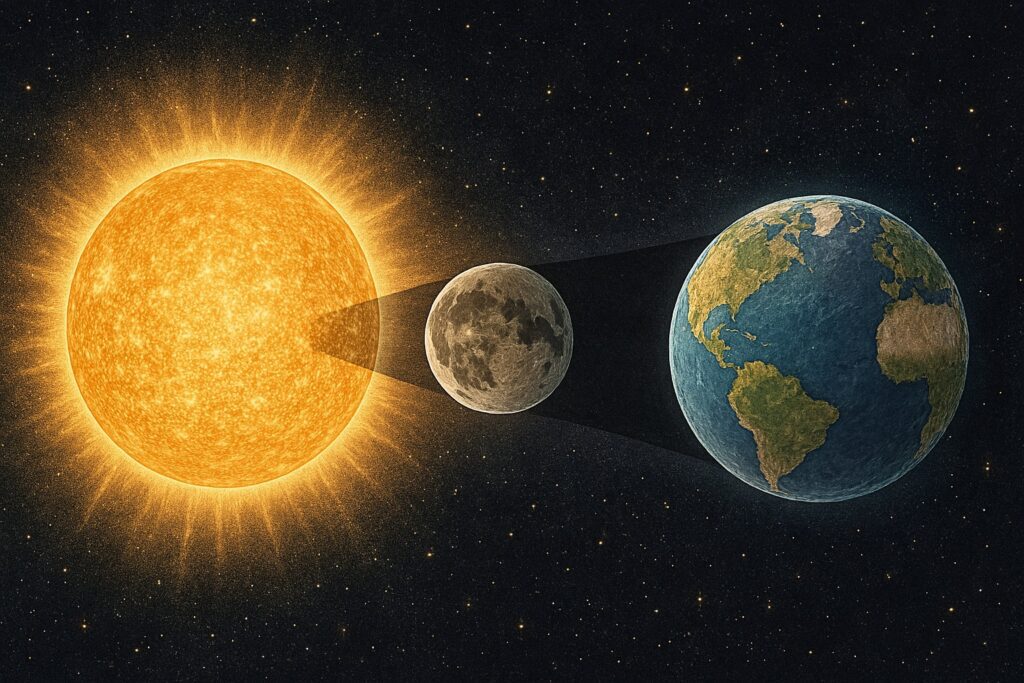
Q1. Solar eclipse occurs when
(a) Earth comes between sun and moon
(b) Moon is at right angle to the earth
(c) Moon comes between sun and earth
(d) Sun comes between moon and earth
(UPSC Prelims 1979)
Answer: (c) Moon comes between sun and earth
Explanation: A solar eclipse takes place when the Moon moves directly between the Sun and the Earth, causing the Sun’s light to be blocked either partially or completely. This alignment leads to the Moon casting a shadow on Earth, and the eclipse is visible only from specific regions where this shadow falls. The Moon must be in its new moon phase for this phenomenon to occur.
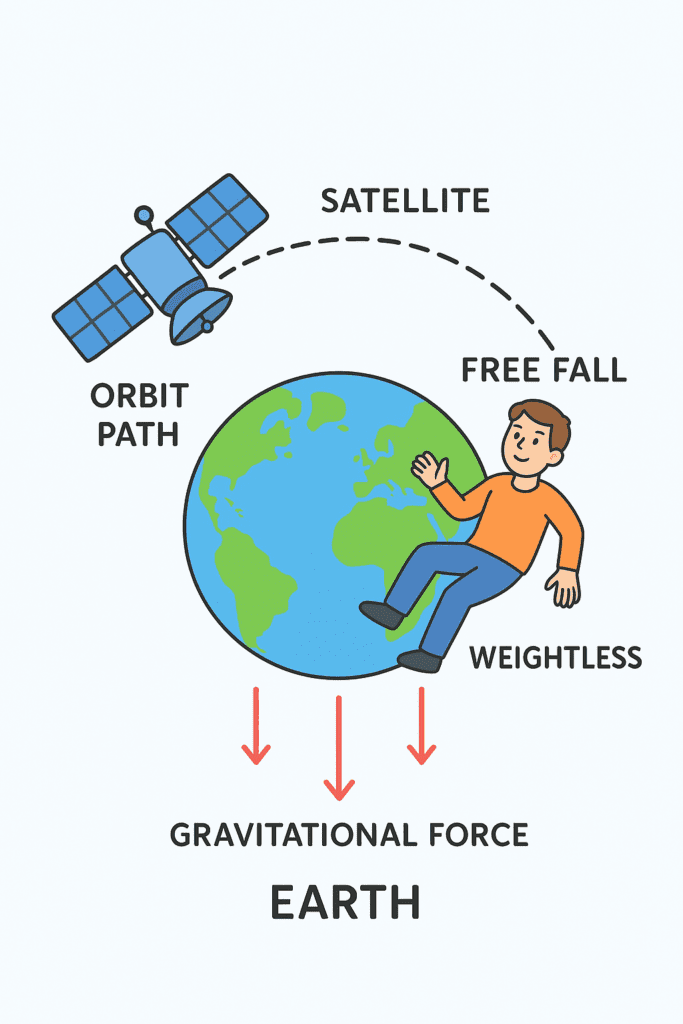
Q2. When a man circles round the earth in a satellite, then
(a) His mass becomes zero but weight remains constant
(b) Mass remains constant but weight becomes zero
(c) Both mass and weight remain constant
(d) Both mass and weight remain zero
(UPSC Prelims 1979)
Answer: (b) Mass remains constant but weight becomes zero
Explanation: In a satellite orbiting Earth, a person experiences weightlessness due to the free-fall condition of orbit. While mass is an intrinsic property and remains unchanged, weight depends on gravitational force. In orbit, the person is in continuous free fall, which results in zero apparent weight, even though gravity is still acting.
Q3. The weight of an object at the poles is greater than at the equator. This is because
(a) Of the shape of the earth
(b) The attraction of the moon is maximum at the earth’s surface
(c) The attraction of the sun is maximum at the earth’s surface
(d) Gravitational pull is more at the poles
(UPSC Prelims 1979)
Answer: (d) Gravitational pull is more at the poles
Explanation: The Earth is not a perfect sphere; it is slightly flattened at the poles and bulging at the equator. This shape causes the distance from the center of the Earth to the poles to be less than to the equator. As a result, the gravitational force is stronger at the poles, making the weight of objects greater there.
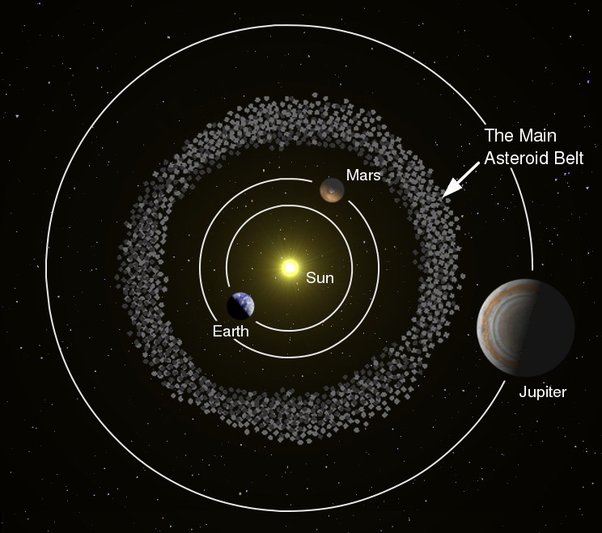
Q4. The minor planets revolving between the orbits of Mars and Jupiter are called
(a) Asteroids
(b) Comets
(c) Meteors
(d) Novas
(UPSC Prelims 1979)
Answer: (a) Asteroids
Explanation: Asteroids are small rocky bodies that orbit the Sun, primarily found in the asteroid belt between Mars and Jupiter. They are considered minor planets and differ from comets, which contain ice and dust.
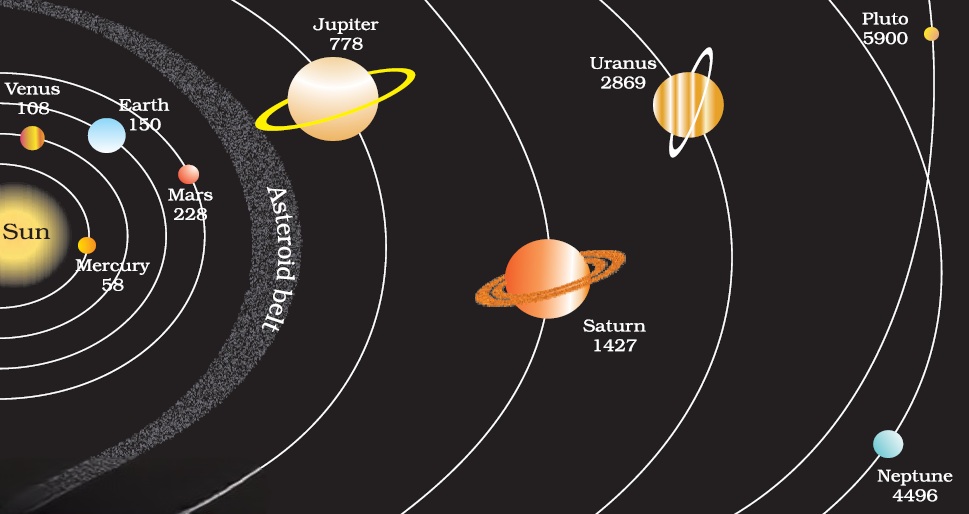
Q5. The planets nearest to Sun are
(a) Mercury and Mars
(b) Earth and Mercury
(c) Mercury and Venus
(d) Mercury and Uranus
(UPSC Prelims 1979)
Answer: (c) Mercury and Venus
Explanation: Mercury is the closest planet to the Sun, followed by Venus. Their proximity results in high surface temperatures, and they orbit the Sun faster than other planets due to strong gravitational pull.
Q6. The rising of evening star Venus indicates
(a) South pole
(b) North pole
(c) East
(d) West
(UPSC Prelims 1980)
Answer: (d) West
Explanation: Venus, known as the evening star, appears in the western sky after sunset, helping in directional orientation and celestial navigation.

Q7. It takes 11 seconds for the light to reach the earth from moon and 8 minutes from the sun. How much time will it take from the nearest bright star to reach the earth?
(a) 4.5 minutes
(b) 45 minutes
(c) 45 months
(d) 4.3 light years
(UPSC Prelims 1981)
Answer: (d) 4.3 light years
Explanation: The nearest bright star to Earth is Alpha Centauri, and light from it takes approximately 4.3 light years to reach us. This means light travels for 4.3 years before becoming visible on Earth, highlighting the vast distances in space.

Q8. U.S.A. found rings around which planet ?
(a) Venus
(b) Jupiter
(c) Mars
(d) Pluto
(UPSC Prelims 1981)
Answer: (b) Jupiter
Explanation: The USA’s space missions discovered rings around Jupiter, which were previously unknown. Though not as prominent as Saturn’s, Jupiter’s rings are composed of dust particles and were detected using space probes like Voyager.
Q9. Mark the correct answer
(a) Planets have an apparent motion and twinkle
(b) Planets have no apparent motion but twinkle
(c) Planets have an apparent motion but do not twinkle
(d) Planets have no apparent motion and do not twinkle
(UPSC Prelims 1983)
Answer: (c) Planets have an apparent motion but do not twinkle
Explanation: Planets show apparent motion across the sky due to their orbit around the Sun, but they do not twinkle because they are closer to Earth and their light passes through the atmosphere more steadily than that of stars.
Q10. Assertion: The same side of the moon is always seen from the earth.
Reason: The moon rotates on its axis once in each orbital revolution.
(a) If both A and R are true but R is not the reason for A
(b) If both A and R are true but R is the reason for A
(c) If neither A nor R is correct
(d) If A is correct but R is wrong
(UPSC Prelims 1983)
Answer: (b) If both A and R are true but R is the reason for A
Explanation: The moon’s synchronous rotation means it rotates once per orbit, causing the same side to always face Earth. Both statements are true, and the reason explains the phenomenon.
Q11. Which comet appears after 76 years and likely to appear in 1986?
(a) Halley’s comet
(b) Biela’s comet
(c) Turtle’s comet
(d) None of these
(UPSC Prelims 1984)
Answer: (a) Halley’s comet
Explanation: Halley’s Comet is a periodic comet that appears approximately every 76 years. It was last visible in 1986, and its predictable return makes it one of the most famous celestial bodies in history.
Q12. Assertion (A): Eclipses do not occur on all full moon and new moon days.
Reason (R): The moon revolves round the earth in an elliptical orbit
(a) A and R both are incorrect
(b) A is correct but R is incorrect
(c) A and R are correct and R is the correct explanation of A
(d) A and R are correct but R is not the correct explanation of A
(UPSC Prelims 1984)
Answer: (d) A and R are correct but R is not the correct explanation of A
Explanation: Eclipses do not occur on every full moon or new moon because the moon’s orbit is tilted about 5 degrees to the Earth’s orbital plane. This means the moon often passes above or below the Earth’s shadow, preventing an eclipse. The elliptical nature of the orbit affects distance, not alignment, so it is not the correct explanation.