Q1. At which place Gautama Buddha delivered his first sermon ?
(a) Sarnath
(b) Lumbini
(c) Bodh Gaya
(d) Vaishali
(UPSC Prelims 1979)
Answer: (a) Sarnath
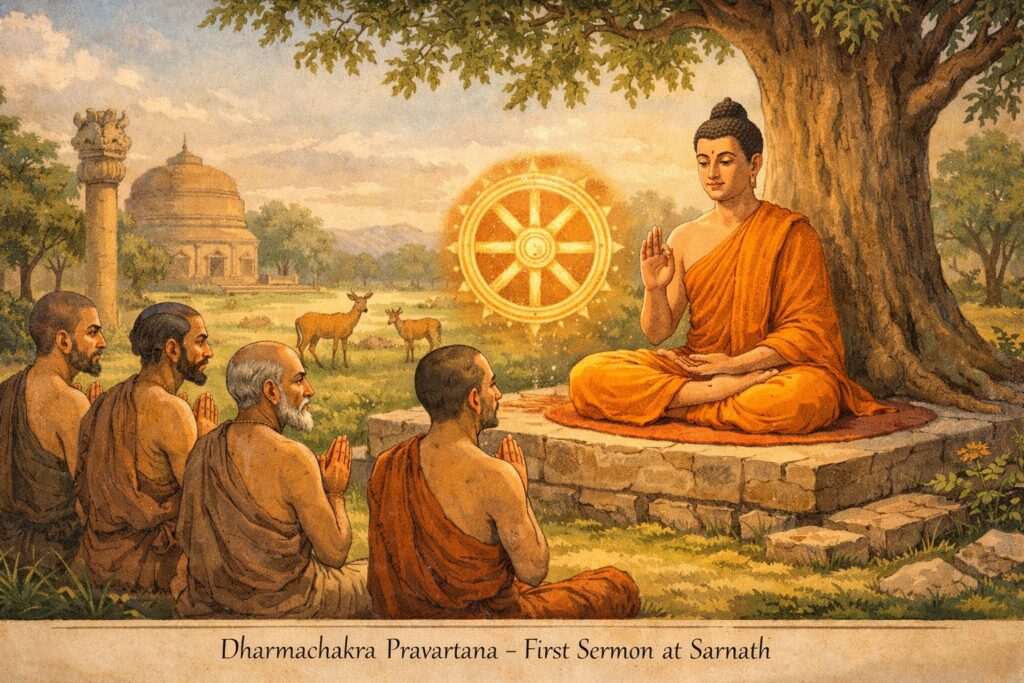
Explanation: Gautama Buddha delivered his first sermon at Sarnath, known as the Dharmachakra Pravartana, marking the beginning of his teaching journey.
Q2. In which way Sarnath is associated with Lord Buddha ?
(a) He resided there
(b) He was born there
(c) He ruled there
(d) He preached his first Sermon there
(UPSC Prelims 1980)
Answer: (d) He preached his first Sermon there
Explanation: Sarnath is the site where Lord Buddha delivered his first sermon, known as the Dharmachakra Pravartana, marking the beginning of the Buddhist Sangha.
Q3. Which of the following is the most important cause for the decline of Buddhism after Ashoka?
(a) Non-patronage by the kings
(b) Condemnation of animal sacrifices
(c) Growth of licentious practices in Buddhist centres
(d) Allegiance to the middle path
(UPSC Prelims 1980)
Answer: (a) Non-patronage by the kings
Explanation: After Ashoka, royal patronage for Buddhism declined, leading to reduced support, loss of monastic discipline, and eventual decline of the religion in India.
Q4. Main preachings of Buddha were in regard to
(a) Right faith and conduct
(b) Love of God
(c) Practice of rituals
(d) Idol worship
(UPSC Prelims 1984)
Answer: (a) Right faith and conduct
Explanation: Buddha’s teachings emphasized the Eightfold Path, which includes right view, right conduct, and right livelihood. He rejected ritualism and idol worship, focusing instead on ethical living and mental discipline.
Q5. Gautam Buddha attained Nirvana at
(a) Bodh Gaya
(b) Sarnath
(c) Kushi Nagar
(d) Lumbini
(UPSC Prelims 1985)
Answer: (a) Bodh Gaya
Explanation: Nirvana, or enlightenment, was attained by Gautam Buddha under the Bodhi tree at Bodh Gaya. This marks the spiritual awakening that led to the founding of Buddhism.
Q6. Which of the following can be regarded as the chief contribution of Buddhism to India ?
(a) Art and literature
(b) Architecture
(c) Ahimsa and self-purification
(d) Rituals
(UPSC Prelims 1985)
Answer: (c) Ahimsa and self-purification
Explanation: Buddhism’s core teachings emphasized Ahimsa (non-violence) and self-purification, which deeply influenced Indian society and ethical thought. These principles became central to social reform movements and spiritual practices, shaping India’s moral landscape.
Q7. Arrange the following Buddhist councils in a chronological order
(1) Vaishali
(2) Rajagraha
(3) Patliputra
(4) Sreenagar
(a) 1, 4, 3, 2
(b) 3, 2, 1, 4
(c) 4, 1, 2, 3
(d) 2, 1, 3, 4
Answer: (d) 2, 1, 3, 4
Explanation: Chronological order of Buddhist Councils:
- 1st – Rajagraha
- 2nd – Vaishali
- 3rd – Patliputra
- 4th – Sreenagar
This sequence reflects the historical development of Buddhist doctrine and organization.
Q8. Of the following, the oldest Sanskrit poet, whose composition still remains in original classical style, is
(a) Asvaghosa
(b) Dandin
(c) Kalidasa
(d) Bhavabhuti
(UPSC Prelims 1987)
Answer: (a) Asvaghosa
Explanation: Asvaghosa, a Buddhist philosopher and poet, is considered one of the earliest classical Sanskrit writers, known for works like Buddhacharita. His style laid the foundation for later Sanskrit literature.
Q9. The Buddhist sculpture and art is found at
(a) Mahabalipuram
(b) Kanchi
(c) Vijayanagar
(d) Amravati
(UPSC Prelims 1987)
Answer: (d) Amravati
Explanation: Amravati, in Andhra Pradesh, is renowned for its Buddhist sculptures and stupa art, dating back to the Satavahana period. It showcases intricate carvings and depictions of Buddha’s life.